Bangladesh garment wage talks collapse as workers reject employer offer
Negotiations over the minimum wage in Bangladesh's textile sector ended in deadlock on Monday, raising fears that industrial strikes will continue.
By Jisoo Kovalenko ·
Representatives of garment workers in Bangladesh have formally rejected a wage proposal presented by factory owners. The disagreement occurred during a session of the government appointed wage board on Monday, where the two sides failed to reach a consensus. This breakdown in negotiations suggests that the weeks of strikes and protests regarding minimum pay may continue to disrupt the industry.
Babul Akhter, a worker representative on the wage board, stated to reporters that the employer's offer falls far short of the demands previously articulated by labor groups. Although the board maintained confidentiality regarding the exact figure, Chairman Judge Syed Azad Subhani indicated that the proposed monthly minimum wage was set above 14,500 taka, which is approximately 116 US dollars.
The gap in expectations between the two parties remains significant. Worker representatives had submitted a formal proposal calling for a monthly minimum of 32,000 taka, or 258 US dollars, for the lowest regular pay grade. They also requested 30,000 taka, equivalent to 241 US dollars, for apprentices. The disparity between this demand and the employer's confidential offer has left the path to an agreement unclear.
The garment sector is a cornerstone of the Bangladeshi economy, generating approximately 38 billion US dollars in annual revenue. The industry employs around four million people and accounts for roughly four fifths of the country's total export earnings. As the world's second largest garment exporter after China, the sector is critical to national stability.
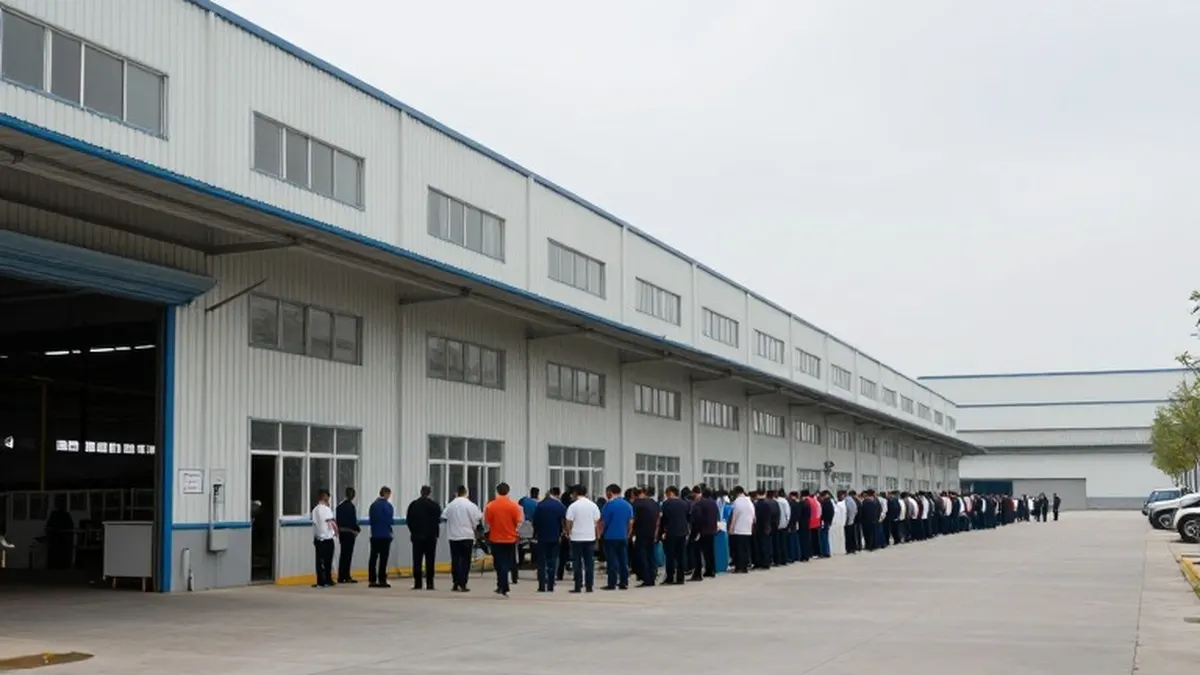
Despite its economic importance, the industry has faced widespread unrest since October. Strikes have disrupted production at factories across the country, leading to the closure of approximately 500 of the more than 4,000 clothing manufacturing facilities. Workers argue that their current wages have failed to keep pace with the rising costs of food, housing, transport, and healthcare.
The Bangladesh Garment Manufacturers and Exporters Association provided estimates of the financial impact of the recent disruptions. The organization calculated that 317 factories lost 428 million US dollars in production value between November 1 and November 18. These figures highlight the tangible economic consequences of the ongoing labor dispute.
The current standoff echoes dynamics from the previous wage review cycle in 2023. During that negotiation, labor groups rallied for a monthly minimum of at least 23,000 taka, or 185 US dollars. The government ultimately set the rate at 12,500 taka, which is 100 US dollars. Although unions initially rejected that figure, they eventually accepted it after prolonged discussions.
In the current cycle, workers are pushing for an increase of around 140 percent. Their frustration has intensified due to the closure of approximately 500 plants by employers. The situation is further complicated by a specific provision in the country's labor laws, often described as a no work no pay clause. This rule allows factory owners to suspend operations and withhold wages when production is disrupted, a practice that has heightened tensions between labor and management.