Nevada Vault: Pentagon releases plans for underground UAP storage facility
A 538-page report from a 2009 government contractor describes a proposed 5,000-square-foot bunker in North Las Vegas for holding exotic materials and hardware.
By Jisoo Kovalenko ·
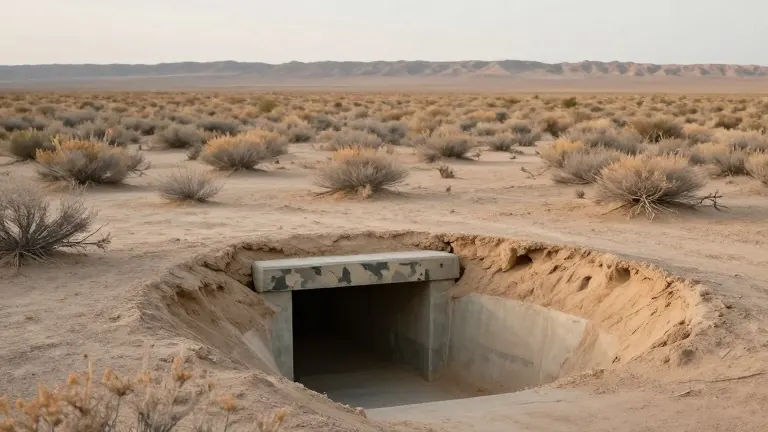
The Pentagon released a 538-page report on Friday that details plans for a highly secure underground vault in Nevada designed to store exotic material or tissue. The document, produced in July 2009, is part of a new batch of 43 files released as the eighth installment of unexplained aerial phenomenon records.
The report was created by Bigelow Aerospace Advanced Space Studies, a government contractor working under a Defense Intelligence Agency program. Congress funded the initiative at the urging of then-Sen. Harry Reid to study potential future aerospace threats. The 538-page document states that the company identified a need for a secure location to store hardware and biological samples obtained from corporate entities or private groups, including those located in Brazil.
According to the text, the facility was to be situated at the Bigelow Aerospace facility in North Las Vegas. The design called for a vault buried under 15 to 20 feet of dirt. The structure would feature 5,000 square feet of interior space, walls three feet thick, and a heavy steel door. The report noted that any surface structures protruding from the ground would be extensively camouflaged to maintain secrecy.
There is no public record indicating that the vault was ever constructed. Subsequent reports released by the Pentagon make no mention of the facility. A Defense Intelligence Agency official assessed the company's reports as having limited value several months after the document was written. The Pentagon research project concluded in 2012. The parent company, Bigelow Aerospace, laid off its entire workforce in 2020.
While a copy of the report had appeared online previously, Friday marked the first time the Pentagon made the document public. The new release also includes files and videos of more recent encounters. Three video clips submitted to the Pentagon's All-domain Anomaly Resolution Office show white dots moving across the screen.
Another file details strange detections captured by a civil air-surveillance radar in 2023. Eight detections were recorded over 84 seconds at altitudes between 55,000 and 70,000 feet. The Pentagon stated that if the detections were associated with a single continuous track, their cumulative point-to-point displacement would be approximately 38.5 miles. This calculation yields a minimum mean horizontal ground-speed estimate of 1,650 miles per hour.
The release includes historical documents from the Air Force and CIA dating to the 1950s. One 1953 account was written by Clarence Kelly Johnson, the chief engineer for Lockheed who later designed the U-2 and SR-71 spy planes. Johnson told the Air Force that he spotted a dark, elliptical object hanging motionless against a gold and red sky while watching the sunset at his California ranch. He wrote that he wondered why the object was so dark considering the sun was behind it, and he immediately thought an aircraft had made an intense smoke trail.
Johnson stated that he watched the object through binoculars before it sped off in a long shallow climb. At about the same time, a Lockheed test crew flying offshore reported chasing what looked like a very large flying wing that shrank to a mere speck. An Air Force record included in the file categorized the sighting as a lenticular cloud.