India pledges $1.62 billion aid package to Nepal after historic Delhi visit
Nepali Prime Minister Balen Shah returned home with major financial commitments from India, including a substantial aid package for flood recovery and new trade agreements.
By Jisoo Kovalenko ·
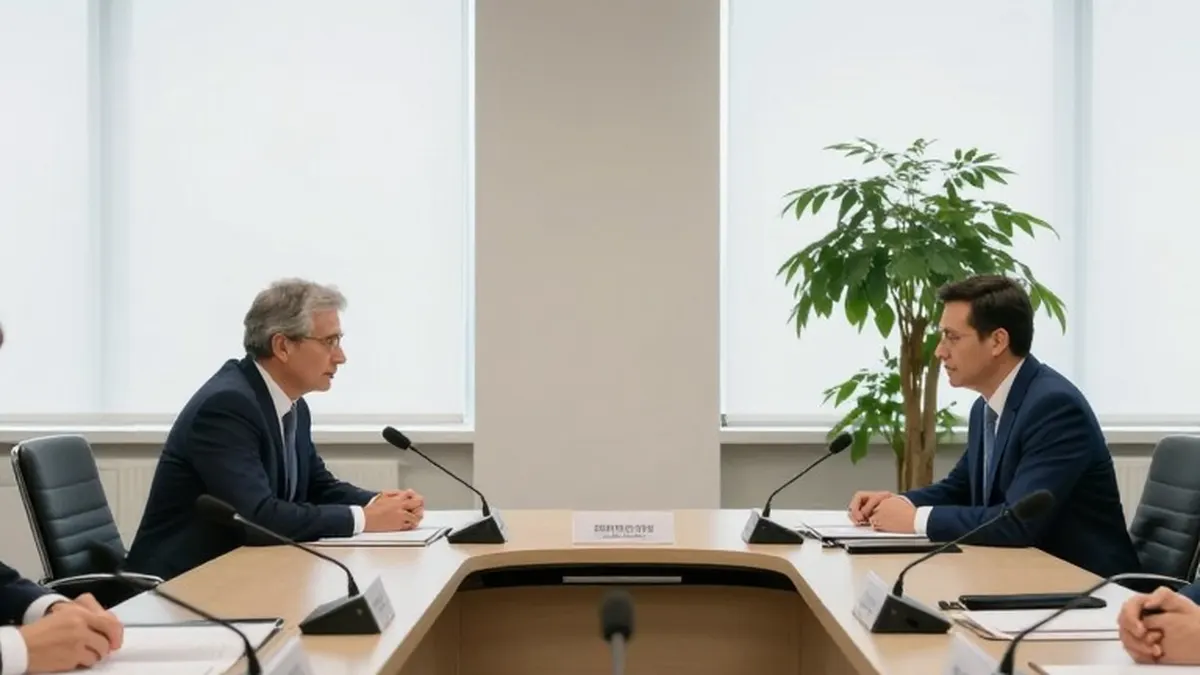
Nepal’s Prime Minister Balen Shah arrived in the Indian capital of Delhi for his first official visit, aiming to reset a relationship that has been marked by years of friction. Shah, who has consistently advocated for Nepal to be treated as an equal by its powerful neighbors, faced a significant test of this diplomatic approach. The meeting highlighted a stark generational contrast between the two leaders. Shah, 36, appeared in his characteristic black suit and sunglasses, standing beside India’s Prime Minister Narendra Modi, 76, who was dressed in white. Shah rose to prominence after a wave of Gen Z-led protests removed his predecessor from power, while Modi is currently serving his third term and has recently dealt with student-led demonstrations within India.
Despite their differing backgrounds, both leaders appeared committed to projecting a warmer alliance. The state visit included the exchange of gifts, the inspection of a military guard of honor, and the joint flagging off of a new cross-border train service. For Nepal, the diplomatic engagement carried stakes that extended well beyond symbolic gestures. The two nations announced a series of agreements covering trade, hydropower, transport, and educational opportunities for young Nepalis. Most significantly, India unveiled a support package worth 1.62 billion dollars, equivalent to 1.22 billion pounds, to assist Nepal in recovering from the devastating floods that struck earlier this year.
The floods resulted in the deaths of more than 1,400 people, with thousands remaining missing. Shah’s government has faced criticism regarding its support for families who lost homes and loved ones. The country now faces a massive reconstruction challenge, with government estimates suggesting the rebuilding effort could cost as much as 4.8 billion dollars. When addressing the United Nations General Assembly in September, Shah warned that when climate disasters devastate poorer nations, the solution should not simply be another mega-loan. In response, Modi pledged nearly 1.6 billion dollars in Indian support, with the majority coming as a line of credit for energy projects. This is supplemented by approximately 400 million dollars in grants dedicated to reconstruction and infrastructure.
Former senior Nepali diplomat Vijay Kant Karna described the package as a significant amount that could help stabilize the often uneasy relationship between the two countries. As a Hindu-majority nation situated between India and China, Nepal has long navigated competing interests from its two giant neighbors. Allegations of political interference and an unresolved border dispute have frequently complicated ties with India. Former Prime Minister KP Sharma Oli, who leads a communist party, was widely viewed as being closer to China. By contrast, Shah emerged as a political outsider when elected earlier this year. The former rapper, who was then 35, led a party that was only four years old at the time.
Shah’s new approach to dealing with India may explain why the border dispute was largely absent from the leaders' public remarks, although the joint statement acknowledged that outstanding issues remained. Govind Pokharel, a former vice-chairman of Nepal’s National Planning Commission, suggested that Shah’s government may have chosen to set contentious issues aside to secure progress on more immediate development needs. Pokharel noted that while the government can convince young Nepalis that the issue will be handled later, failing to address it in the future could lead to criticism. Veteran Indian diplomat Anil Trigunayat observed that both sides appear to have opted to leave the dispute to established mechanisms rather than engage in what he described as cartographic aggressions.
The Delhi visit yielded other gains for Nepal, which is a landlocked country heavily dependent on India for trade. Nepal secured access to two additional Indian ports, Kandla and Paradip. The two sides also agreed to improve road and rail connectivity. The leaders jointly inaugurated a train service linking Ayodhya in India, revered by Hindus as the birthplace of Lord Ram, with Janakpur in Nepal, traditionally regarded as the birthplace of his wife Sita. However, there was disappointment regarding aviation. Nepal has long sought greater access to Indian airspace to attract international traffic to its airports at Bhairahawa and Pokhara. Some analysts believe the lack of an agreement reflects Indian concerns over Chinese involvement in these two airport projects.
Trigunayat stated that the airport in Pokhara can pose certain security challenges for India, making it a more complicated issue to resolve. India did, however, agree to make an existing air route linking Kathmandu, Bhairahawa, and Lucknow bidirectional. Pokharel remarked that Nepal invested a huge amount of money in those airports and that while the outcome fell short of expectations, the bidirectional route represents a breakthrough. Shah must now manage relations with China as he seeks to balance the interests of Nepal’s two much larger neighbors. For now, he returns home with substantial financial commitments from India as Nepal continues the long task of rebuilding.