Alexandra children publish anthology to combat local literacy gap
A grassroots reading club in Johannesburg has helped 50 students write and publish a collection of stories that reflect their daily lives in the township.
By Luca Shevchenko ·
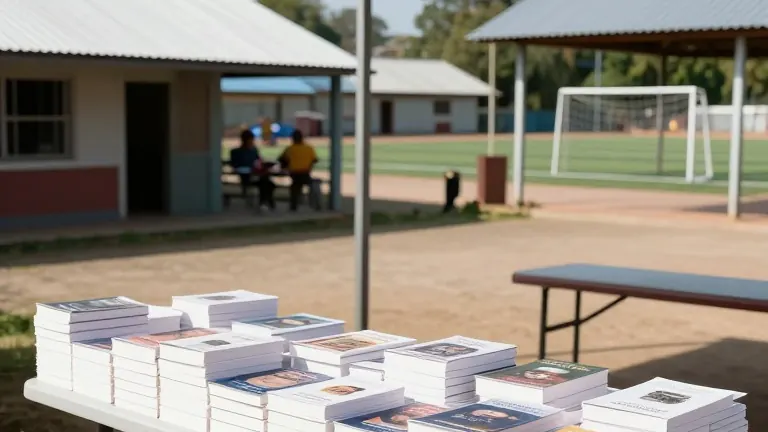
Seven young residents of Alexandra township in Johannesburg have published a self-published anthology titled From Gomora to the World. Stories from Alex. The collection marks the culmination of a weekend literacy program that aims to improve reading skills among local children. The book launch took place on a recent Saturday at the Kwabhekilanga Sports Ground, where community members gathered to sign copies and discuss the creative process.
South Africa faces a widespread challenge in education. One international study indicates that 81% of 10-year-olds in the country cannot read for meaning in any of the 12 official languages. The Read Alex program, launched by the Run Alex Athletics Club, operates as a free weekend reading club in English. Approximately 50 children participate in the program. Annual activities include a public speaking competition, two spelling bees, and a book drive on Mandela Day. This drive collects around 500 volumes, which are distributed to students and local libraries.
Fiona Mogane, age 13, is one of the authors featured in the anthology. She wrote the story Lindani's Modelling Journey. The narrative follows a girl whose mother is an alcoholic and spends government welfare money on alcohol. Lindani worries about following a similar path but finds strength in her own character. The protagonist sells homemade scones to raise funds for a modeling contest. She places second in the competition and is crowned princess. Fiona, who is raised by a single mother in Alexandra, notes that township life teaches residents about Ubuntu, a philosophy centered on community well-being and shared responsibility.
Phelelisa Somana, a coordinator for the book project, observed the maturity in Fiona's writing. Somana stated that the story contained deep themes she did not expect from a child. She added that the experience reminded her that children are often smarter and more observant than they believe. Tebogo Selekane, an English teacher at Kwa-bhekilanga secondary school, noted that two of her students contributed to the anthology. She reported that these students have shown increased confidence and improved reading skills since joining the weekend program.
Anita Maloka, also 13, wrote a story about a rural girl who moves to Johannesburg for school. The character faces overcrowding and scarce textbooks but works toward a scholarship at a school with a science lab and computer programming room. Anita dreams of becoming a marine biologist and is currently pursuing a scholarship to leave the township. She described life in Alexandra as a place where children travel, explore, and pursue their dreams, rather than focusing solely on struggle.
Wandile Mathe, a 21-year-old writer and joint coordinator of the project, highlighted the cultural context of the participants. He described South Africans as natural storytellers who comment on daily life in taxis, shops, and lines. The stories in the anthology reflect this tradition, addressing topics such as peer pressure, dangerous men on the street, the loss of parents, and the inability to pay school fees. Despite these challenges, the characters in the book find ways to overcome obstacles and form friendships.
The lack of books in the home contributes to the literacy crisis. A UNICEF study found that two-thirds of South African children do not have books at home. Government data shows that only 15% of public schools in South Africa have a functioning library. Basic Education Minister Siviwe Gwarube cited the statistic that 80% of 10-year-olds cannot read for meaning in any language. The government is investing ten billion rand, or $58 million, over the next three years to improve early childhood development centers. This investment aims to build stronger early learning foundations for students before they start primary school.
The anthology provides a tangible output of the Read Alex program's efforts. The stories written by the children serve as a record of their experiences in a high-density area with high crime rates. The publication offers a platform for young voices to share their perspectives on poverty, family dynamics, and personal ambition. The book launch event demonstrated community support for the students and their creative work.